The best food dehydrator for jerky and fruit
The Excalibur Select Series at $179.99 is the best food dehydrator for jerky, thanks to horizontal airflow that dries every tray evenly at an adjustable temperature. The Cosori 5 Tray at $119.99 is the best budget option for smaller batches of fruit and vegetables.
The Excalibur Select at $179.99 is the pick for jerky specifically, because horizontal airflow across an adjustable temperature range dries every tray at the same rate without rotation, which matters most on a dense, thin-sliced protein where uneven drying leaves some pieces underdone. The Cosori 5 tray at $119.99 is the better buy for someone drying mostly fruit and vegetables in smaller batches, and either machine is a real upgrade over an oven set to its lowest temperature, which rarely goes low enough or holds steady enough for a genuinely even dry, and which heats an entire kitchen for hours in the process of drying a single tray of fruit.
The three tiers
Every roundup here is built as three genuinely different answers rather than one flat ranking, because that is how people actually shop: a first purchase, a considered upgrade, and a ceiling. The expert pick is not the best pick for most readers, and the section below says who should skip it.
Cosori Food Dehydrator, 5 Stainless Trays
Five stainless trays and 3.1 square feet of drying area with a rear-mounted fan, at $119.99, so every tray dries at roughly the same rate without needing to rotate them front to back.
Skip it if: Skip it if you are drying jerky by the batch for storage: 3.1 square feet fills up fast once you are slicing a whole flank steak's worth of strips.
Excalibur Select Series Food Dehydrator
The cheaper Excalibur, with the same horizontal airflow design as the larger model, at $179.99. This is the size and airflow combination most jerky guides assume you own.
Skip it if: Skip it if you regularly dry a full harvest of fruit and vegetables at once: the tray count here is comfortable for jerky-sized batches, not for putting up a season's worth of dried tomatoes in one run.
Excalibur Performance Series Food Dehydrator, 10 Tray
Ten trays of the same horizontal airflow design, at $379.99, for anyone drying jerky, fruit or vegetables in harvest-sized batches rather than a single evening's project.
Skip it if: Skip it if you dry a few pounds of jerky or a couple of trays of fruit at a time. Ten trays of unused capacity is a waste of both money and counter space for occasional use.
Gear that fits these numbers
The three picks side by side
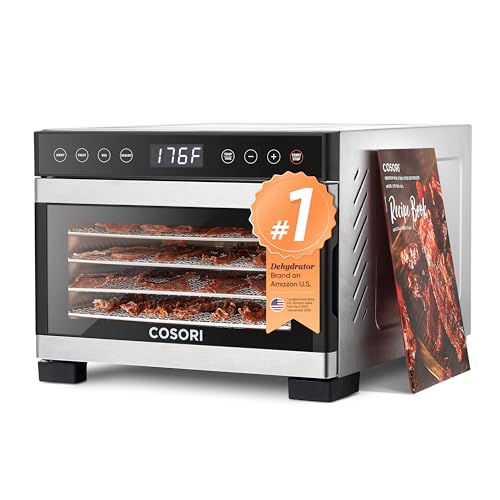
Cosori Food Dehydrator, 5 Stainless Trays
The small one, and still stainless trays rather than plastic, which matters at the 160 F jerky temperature.

Excalibur Select Series Food Dehydrator
The cheaper Excalibur, with the same horizontal airflow that makes the brand worth the premium in the first place.

Excalibur Performance Series Food Dehydrator, 10 Tray
The square box with horizontal airflow that every long form drying guide is written around.
Prices when last checked. They change often.
Rear fan versus horizontal airflow: does the difference matter?
A rear-fan dehydrator like the Cosori 5 tray or Cosori 10 tray pushes air from behind the stack of trays, which dries every tray at close to the same rate and is why these machines do not need tray rotation. A horizontal airflow design like the Excalibur Select or Excalibur 10 tray pushes air front to back across each tray individually inside a square cabinet, which most long-form jerky and fruit leather guides are written around because it tends to dry a dense, thin protein more evenly across a full tray than a round, top-mounted fan design does. Both airflow styles work; the practical difference shows up most on thin-sliced jerky, where an uneven dry leaves some strips still moist while others are already brittle.
The Magic Mill Pro splits the difference at $149.99, with a rear fan behind seven full-size trays and 600 watts of drive, which is more power behind that fan than most machines in its price range and a reasonable middle ground between the cheapest Cosori units and a full Excalibur.
Food dehydrator comparison
Tray count, drying area and price across the current lineup. Trays sold separately, such as the silicone leather sheets, work across most of these machines as long as the tray diameter matches, which is worth checking before buying accessories for a machine you do not already own.
| Model | Trays | Area | Price |
|---|---|---|---|
| Cosori 5 tray | 5 stainless | 3.1 sq ft | $119.99 |
| Magic Mill Pro | 7 full size | 600 W, rear fan | $149.99 |
| Cosori 6 tray | 6 stainless | 6.5 sq ft | $143.97 |
| Excalibur Select | Horizontal flow | Adjustable temperature | $179.99 |
| Cosori 10 tray | 10 stainless | 16.2 sq ft | $299.99 |
| Excalibur 10 tray | 10, horizontal flow | Adjustable temperature | $379.99 |
Drying temperatures for common foods
These are typical manufacturer manual ranges. Actual time depends on slice thickness and kitchen humidity, so treat the finished texture as the real test rather than the clock alone.
| Food | Temperature | Typical time |
|---|---|---|
| Fruit slices, apple or banana | 135 F | 6 to 12 hours |
| Vegetable slices, zucchini or carrot | 125 to 130 F | 6 to 10 hours |
| Beef jerky | 160 F | 4 to 6 hours |
| Turkey jerky | 165 F | 4 to 6 hours |
| Fruit leather | 135 F | 6 to 10 hours |
Why does slice thickness change drying time so much?
Moisture has to travel from the center of a slice to its surface before it can evaporate, and that distance is what actually sets drying time, not the food's weight. A slice cut twice as thick does not simply take twice as long: because moisture has to migrate through twice the distance in every direction, doubling thickness typically adds noticeably more than double the drying time. This is why jerky recipes are specific about a quarter inch versus an eighth inch slice, and why a batch of unevenly hand-cut strips finishes unevenly no matter how good the dehydrator is. A mandoline or a consistent knife technique matters as much as the machine for an even, predictable dry, and it is a cheaper upgrade than a bigger dehydrator if uneven batches are the actual complaint.
Drying alone does not make jerky safe. What does?
A dehydrator's chamber temperature and a piece of meat's internal temperature are two different numbers, and drying time alone does not guarantee the meat itself ever reached a safe internal temperature all the way through. The published guidance is to bring the meat to its safe minimum internal temperature, 160 F for beef and other ground or whole-muscle red meat and 165 F for poultry, either before slicing and drying or after the dry is finished, checked with an instant read thermometer such as the Thermapen ONE rather than assumed from the dehydrator's dial. We do not reproduce specific pathogen kill-step hold times here: those come from the USDA FSIS Appendix A lethality tables for specific products, fat content and salt level, and a wrong number in that category is the kind of mistake that can actually make someone sick. See the jerky safety guide for how that step fits into a full recipe.
Drying fruit and jerky in the same machine is fine as long as trays and the interior are washed between uses, since raw meat juice can drip onto lower trays during drying. Running jerky on its own trays, positioned so drips do not land on fruit or vegetables below, is the simplest way to avoid cross-contamination entirely.
How we chose
These picks come from published tray counts, airflow design and wattage from the manufacturers, along with recurring themes in verified owner reviews on even drying, unit noise and how well a stated temperature range actually holds under load. We did not dry food on these machines ourselves. Prices are pulled from current listings and are checked at every update.
Gear that fits these numbers
Everything mentioned on this page
Cosori Food Dehydrator, 5 Stainless Trays
The small one, and still stainless trays rather than plastic, which matters at the 160 F jerky temperature.
Excalibur Performance Series Food Dehydrator, 10 Tray
The square box with horizontal airflow that every long form drying guide is written around.

Cosori Food Dehydrator, 6 Stainless Trays
A rear mounted fan dries every tray at the same rate, which is why you do not have to rotate trays the way stacked round dehydrators demand.
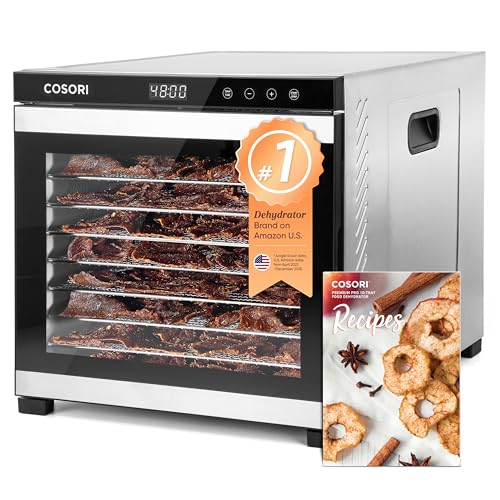
Cosori Food Dehydrator, 10 Stainless Trays
Sixteen square feet of tray, which is a harvest sized machine rather than a jerky sized one.

Magic Mill Pro Food Dehydrator, 7 Trays
Six hundred watts behind a rear fan, which is more drive than most machines in this price band.

ThermoWorks Thermapen ONE
One second and half a degree. On a page about pasteurization that accuracy is not a luxury, it is the difference between a figure meaning something and not.
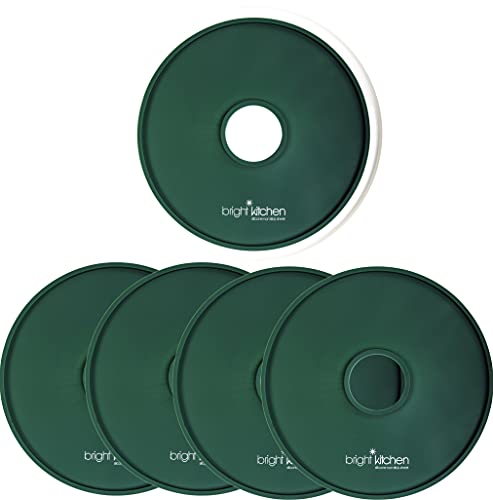
Fruit Leather Silicone Dehydrator Sheets, 4 Pack
Raised edges are the difference between fruit leather and fruit puree in the bottom of your dehydrator.
Prices when last checked. They change often.
Frequently asked questions
Is drying meat at 160 F in a dehydrator enough to make jerky safe?
Chamber temperature and the meat's own internal temperature are not the same measurement. The published guidance is to bring the meat itself to its safe minimum internal temperature, 160 F for beef and 165 F for poultry, checked with an instant read thermometer, either before drying or after, rather than assuming the dehydrator's dial setting alone accomplished that.
What is the difference between a rear fan and a horizontal airflow dehydrator?
A rear-fan machine like the Cosori 5 tray pushes air from behind a stack of round trays, drying each one at close to the same rate without rotation. A horizontal airflow machine like the Excalibur Select moves air front to back across each tray inside a square cabinet, a design most jerky and fruit leather guides are written around for even drying on thin-sliced protein.
How many trays do I actually need for jerky?
A 5 or 6 tray machine like the Cosori 5 tray or Cosori 6 tray comfortably handles a couple of pounds of sliced jerky in one batch. Stepping up to a 10 tray unit like the Cosori 10 tray or Excalibur 10 tray only pays off if you are processing a whole cut of beef or a season's worth of fruit at once rather than an occasional batch.
Does fruit leather need a special tray?
Yes. Pureed fruit runs through the mesh or slots of a standard dehydrator tray, so a solid silicone sheet with raised edges, like Fruit Leather Silicone Dehydrator Sheets, is what keeps the puree contained while still letting it dry. Without one, the puree drips through and pools in the bottom of the machine instead of drying into a sheet.
What temperature should vegetables be dried at compared with jerky?
Most vegetables dry well between 125 F and 130 F, well below the 160 F to 165 F range meat needs to reach its safe minimum internal temperature. Vegetables carry no equivalent pathogen safety requirement the way raw meat does; the lower temperature there is purely about preserving texture and color rather than a safety step.
How do I know when dried food is actually finished?
Texture is the real test, not the clock. Fruit should feel leathery and pliable with no wet, sticky spots when cooled and pressed. Vegetables should feel brittle or leathery depending on the type. Jerky should bend and crack slightly rather than snap cleanly or feel soft and rubbery. Manufacturer time ranges, like those in the table above, are a starting point; humidity and slice thickness both shift the real finish time in either direction.
Sources
Published figures, quoted as published. We do not generate our own time and temperature data.
How we research: we compare manufacturer specifications, owner manuals, published USDA and FSIS figures and recurring themes in verified owner reviews. We do not cook test batches or run instruments, and nothing here is professional food safety advice. When a figure is not published by a source we trust, we say so rather than estimate one.