
Cosori
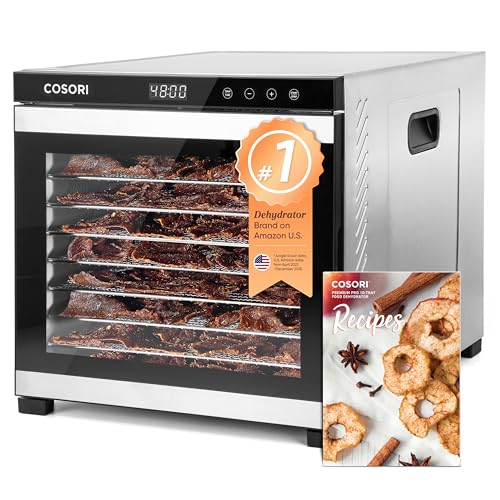
Cosori Food Dehydrator, 6 Stainless Trays
A rear mounted fan dries every tray at the same rate, which is why you do not have to rotate trays the way stacked round dehydrators demand.
Dehydrator time scales with slice thickness: doubling from 6 mm to 12 mm roughly doubles the run. A humid kitchen adds about 25 percent on top. Apple slices quoted at 6 to 10 hours become roughly 15 to 25 hours at double thickness in a humid room.
The formula
adjusted hours = base hours x (thickness mm / 6) x (humid ? 1.25 : 1.00) The 6 mm reference is the slice thickness most manufacturer tables assume without saying so.
Manufacturer ranges are written for a reference slice in a dry room with a normally loaded machine. Thickness and humidity are the two variables that move the number most, and neither is usually stated, which is why the same recipe behaves differently in different seasons.
Gear that fits these numbers
A rear or horizontal fan dries every tray at the same rate, which is why the machines built that way do not ask you to rotate trays halfway through.
A rear mounted fan dries every tray at the same rate, which is why you do not have to rotate trays the way stacked round dehydrators demand.

The square box with horizontal airflow that every long form drying guide is written around.
Sixteen square feet of tray, which is a harvest sized machine rather than a jerky sized one.
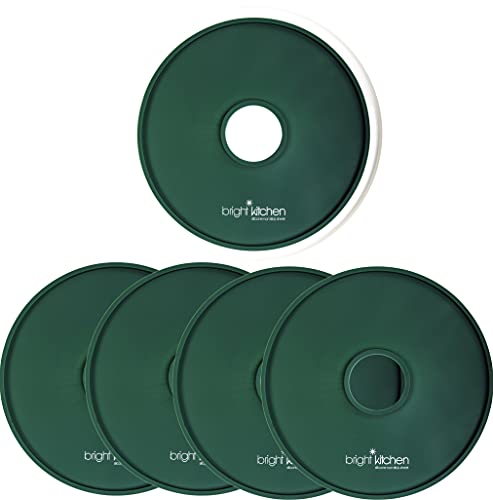
Raised edges are the difference between fruit leather and fruit puree in the bottom of your dehydrator.

The cheaper Excalibur, with the same horizontal airflow that makes the brand worth the premium in the first place.

Six hundred watts behind a rear fan, which is more drive than most machines in this price band.
Prices when last checked. They change often.
Drying is water leaving from the surface, and the rate is limited by how fast water inside can travel to that surface. Thicker slices mean a longer journey, so the run time grows roughly in proportion. It is a gentler relationship than the squared law that governs heating a solid in a water bath, because the moving front is much closer to the surface, but it is the same idea.
A dehydrator works by moving warm air over food and carrying moisture away. If the air already holds a lot of water, it carries away less per pass, and the machine simply takes longer. There is no setting for this. A batch that took eight hours in a dry winter kitchen can take eleven in a humid one, which is usually blamed on the machine.
Roughly in proportion. Doubling the thickness from 6 mm to 12 mm roughly doubles the run time, because water inside the slice has twice as far to travel before it can leave the surface. Consistent thickness matters more than the exact figure: mixed thicknesses on one tray means some pieces are leathery while others are still damp.
Thickness and humidity are the usual answers. Manufacturer ranges assume a reference slice, around 6 mm, in a normally dry room with a normally loaded machine. Thicker slices, a fully loaded machine and a humid kitchen each add time, and a humid room alone can add a quarter to the total.
Cool a test piece completely before judging it, because warm food always feels drier than it is. Properly dried fruit is leathery and bends without snapping, while vegetables should be brittle. Seal a small amount in a jar for a day: if condensation appears on the glass, everything goes back into the machine.
Somewhat, but it introduces case hardening, where the outside dries into a shell that traps moisture inside. That piece then feels done and spoils in storage. Herbs are the extreme case and want around 95 F to keep their volatile oils, and running them hot produces green dust rather than dried herbs.
Drying alone does not make meat safe. The published guidance is to bring the meat to its safe minimum internal temperature, 160 F for beef and 165 F for poultry, either before or after drying, rather than relying on the dehydrator to do it. A machine that only reaches 160 F air temperature does not guarantee the meat gets there.
How this calculator works: it applies the formula above to the numbers you enter. Where a figure is published by the USDA or FSIS we quote it and name the source. Where a figure is derived from a physical model we say so and state the assumptions. Where we have no defensible figure the calculator returns nothing and tells you why, rather than guessing. This is researched general information, not professional food safety advice.