How air fryers actually work, and how to use one correctly
An air fryer is a small convection oven with an aggressive fan, so the standard conversion from a conventional oven recipe is to drop the temperature by 25 F and cut the cooking time by about 20 percent. That conversion is a rule of thumb rather than a guarantee, and crowding the basket is the single biggest reason a batch turns out soggy instead of crisp.
An air fryer is not a magic crisping box. It is a small convection oven with a fan far more aggressive than a full size oven has room for, and everything it produces traces back to that one mechanical fact. Moving a large volume of hot air across a small amount of food strips away the thin layer of cool, moist air that normally clings to whatever is cooking, and stripping that layer away is what builds a crust in a fraction of the time a conventional oven needs. Once you treat the appliance as a small fan oven rather than a countertop mystery box, most of what confuses new owners, from soggy fries to a raw centered muffin, stops being confusing at all.
What is an air fryer actually doing to my food?
A conventional oven heats air and lets it move around a cavity mostly through natural convection: warm air rises, cool air sinks, and the food sits in a fairly still pocket of heat. An air fryer forces the issue with a powerful fan that drives hot air directly across the food's surface at speed, in a chamber small enough that the air has nowhere else to go. That moving air constantly replaces the cooler, moisture laden layer that forms right at the surface of anything cooking, and removing that layer is what lets the surface brown and crisp instead of steaming in its own vapor. It is closer to a convection oven turned up several notches than it is to a deep fryer: there is no oil bath doing the work, just air movement and, usually, a light coating of oil on the food itself.
- A basket style machine like the Ninja Max XL or the Ninja Pro XL pushes air down through a perforated basket
- A glass container model like the Ninja Crispi circulates air around a sealed vessel you can also use for storage
- The Cosori TurboBlaze and most other basket fryers work on the same principle regardless of brand
How do I convert an oven recipe to an air fryer?
The published rule of thumb, echoed in nearly every manufacturer manual, is to drop the oven temperature by 25 F and cut the cooking time by about 20 percent. It is a starting point, not a law: the exact result depends on the food's thickness, how much of it is in the basket, and how aggressive a particular machine's fan is. Set a timer for about 60 percent of the original oven time and check the food then, rather than waiting for the full converted time to run out.
| Oven temperature | Air fryer temperature | Time adjustment |
|---|---|---|
| 350 F | 325 F | Cut about 20 percent, check around 60 percent |
| 375 F | 350 F | Cut about 20 percent, check around 60 percent |
| 400 F | 375 F | Cut about 20 percent, check around 60 percent |
| 425 F | 400 F | Cut about 20 percent, check around 60 percent |
| 450 F | 425 F | Cut about 20 percent, check around 60 percent |
Why did my fries come out soggy, or cook unevenly in the same batch?
Crowding the basket is the single biggest cause of a bad air fryer result, and it fails in two different ways at once. Pieces of food that touch each other block airflow at the point of contact, so that spot never browns no matter how long it runs. Pieces piled deep enough to block the fan's path entirely trap steam underneath them, so the bottom layer effectively boils in its own moisture while the top layer crisps normally. The fix is to cook in a single layer with visible space between pieces, and to run two smaller batches rather than one crowded one. A two zone basket like the DualZone machines makes this easier because it gives two proteins or a protein and a vegetable their own airflow at the same time instead of forcing a choice between crowding one basket or cooking in shifts.
Do I actually need to preheat the basket first?
For anything you want genuinely crisp, yes. Preheating brings the chamber and the basket itself up to temperature before the food's surface starts losing moisture, so the crust starts forming the moment the food goes in rather than several minutes later while the machine is still catching up. Skipping preheat on a food that mostly needs to be heated through, like a frozen appetizer that is already cooked, matters less. Skipping it on fresh cut potatoes or breaded chicken is the difference between a crust and a pale, slightly dried surface that never really browns.
Can I bake cookies or a cake in an air fryer?
Carefully, and not at the temperature the standard conversion rule suggests. Anything that rises, cookies, cakes, quick breads, bakes badly in an air fryer because the aggressive fan sets and browns the outside crust before the interior has had time to lift and set its structure, which leaves a dense or even raw center under a fully baked looking top. Cookies specifically want closer to 320 F, well below what subtracting 25 F from a standard 350 F oven recipe would suggest. Use a dedicated small baking pan sized for the basket, and expect to test one item before committing a full tray to the same settings.
How do I know when chicken or steak is actually done, timer or temperature?
Temperature, every time. An air fryer's fan speed, the exact size of the piece of food, and how full the basket is all shift the actual cook time enough that a timer is a starting estimate rather than an answer. Finish proteins by probing the thickest part with an instant read thermometer such as the Thermapen ONE or the more affordable ThermoPop 2, and cook to the USDA published safe minimum internal temperature for the category: 165 F for poultry, 160 F for ground meat, and 145 F with a three minute rest for whole muscle beef, pork, lamb and veal. A timer tells you when to check. A thermometer tells you when to stop.
Gear that fits these numbers
Everything mentioned on this page

Ninja Air Fryer Pro XL, 6.5 Quart
A litre more basket than the Max XL for roughly the same footprint, which is the whole argument for it.

Ninja Foodi DZ550 DualZone Smart XL Air Fryer, 10 Quart
The DualZone with a cook probe, which is the feature that turns an air fryer from a timer box into something you can actually cook a thick chicken breast in.

Cosori TurboBlaze Air Fryer, 6 Quart
A ceramic, PFAS free basket, which is the reason to pick it over the Ninja equivalents if coating chemistry matters to you.

ThermoWorks Thermapen ONE
One second and half a degree. On a page about pasteurization that accuracy is not a luxury, it is the difference between a figure meaning something and not.
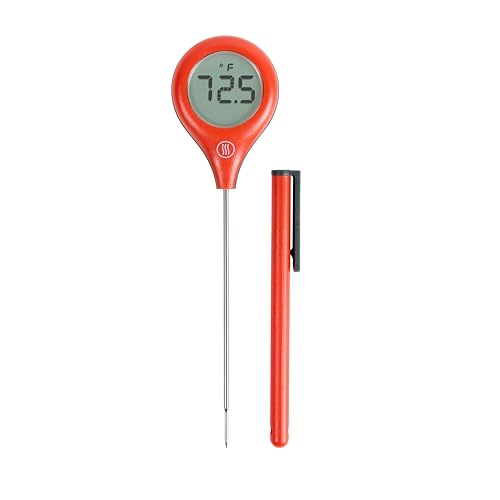
ThermoWorks ThermoPop 2
A third of the Thermapen price for most of the useful accuracy. The right pick if you are buying your first real thermometer.
Prices when last checked. They change often.
Frequently asked questions
Do air fryers actually use less oil than deep frying?
Yes, by a wide margin. A deep fryer submerges food in several quarts of hot oil, while an air fryer only needs a light coating, often a teaspoon to a tablespoon tossed on the food or applied with a mister, because the browning comes from moving hot air rather than from the oil itself. The oil still matters for flavor and for helping the surface brown evenly, but the appliance is not relying on it to transfer heat the way a deep fryer does.
Why does my air fryer cook things faster than the time on the package?
Package times are usually written for a conventional oven or based on a specific brand's chamber size and fan strength, neither of which matches every air fryer on the market. A smaller chamber concentrates the moving air more tightly around the food, which is the entire reason air fryers cook faster than ovens in the first place. Treat the package time as a ceiling, check at roughly 60 percent of it, and adjust for your specific machine over a few uses.
Can I put aluminum foil or parchment paper in the basket?
Generally yes, as long as it does not block the perforations the air needs to pass through and it is weighed down by food so it cannot get pulled into the heating element by the fan. Cut parchment to fit inside the basket rather than overhanging the edges, and avoid covering more than necessary, since covering the whole basket defeats the airflow the appliance depends on.
Is it safe to preheat an empty air fryer basket?
Yes, most manufacturers design the basket coating to tolerate a few minutes of empty preheating, similar to preheating an empty pan on a stove. Avoid leaving it running empty for long stretches beyond what preheating requires, and check your specific model's manual if the basket has a nonstick coating rated for lower maximum temperatures than the machine's dial allows.
Why do my vegetables turn out limp instead of crisp?
Limp vegetables almost always trace back to crowding and moisture rather than temperature. A pile of vegetables traps steam the same way piled fries do, and vegetables with high water content, like zucchini or mushrooms, release even more moisture as they heat. Cut pieces uniformly, toss them lightly in oil, spread them in a genuine single layer, and expect a shorter cook than a starchy vegetable like potato needs.
What temperature should chicken breast reach in an air fryer?
Cook boneless chicken breast to 165 F at the thickest part, which is the USDA published safe minimum internal temperature for all poultry. Because air fryer cook time varies with thickness and basket load more than most appliances, rely on a probe thermometer rather than the clock to confirm it, since a breast that looks browned on the outside is not automatically done at the center.
Sources
Published figures, quoted as published. We do not generate our own time and temperature data.
How we research: we compare manufacturer specifications, owner manuals, published USDA and FSIS figures and recurring themes in verified owner reviews. We do not cook test batches or run instruments, and nothing here is professional food safety advice. When a figure is not published by a source we trust, we say so rather than estimate one.