Best kitchen scale for precision cooking
The Etekcity 0.1 Gram Food Kitchen Scale ($18.99) is the best kitchen scale for precision cooking: tenth-gram resolution at a beginner price, which is what it takes to hit a salt percentage accurately in a brine or ferment.
Etekcity 0.1 g scale at $18.99 is the scale to buy first. Tenth-gram resolution at a beginner-level price removes the single biggest source of error in weight-based cooking: a 1 gram scale rounds, and rounding is invisible on a large batch and enormous on a small one. If you are weighing full stockpots of brine rather than single portions, BOMATA 0.1 g scale at $33.88 keeps that same 0.1 gram resolution across an 11 pound platform large enough for the bigger bowl. If precise salt percentages do not matter to what you cook, Escali Primo at $25.00 is a perfectly good ordinary kitchen scale.
The three tiers
Every roundup here is built as three genuinely different answers rather than one flat ranking, because that is how people actually shop: a first purchase, a considered upgrade, and a ceiling. The expert pick is not the best pick for most readers, and the section below says who should skip it.
Best for general cooking
A simple, accurate 1 gram scale for everyday cooking and baking: weighing flour, portioning dough, checking a recipe by weight instead of by cup.
Skip it if: Not for anyone weighing salt as a percentage of a brine or ferment: 1 gram resolution means 2 percent of 800 grams, or 16 grams of salt, can be off by close to a gram either way, which is a real error at that scale.
Best all-around
Tenth-gram resolution with an included bowl, at a price that makes it the easy first upgrade once you start following brine or ferment ratios by weight.
Skip it if: Not for weighing anything heavier than a home batch comfortably fits in a small bowl; a full stockpot of brine wants a larger platform.
Best for large batches
The same tenth-gram resolution as the Etekcity, spread across a full 11 pound capacity and a larger platform, for weighing bigger brines, cure mixes and batch ferments without switching scales.
Skip it if: Not worth the extra cost over the Etekcity if everything you weigh fits in a standard mixing bowl; the larger platform is the entire reason to pay more here.
Gear that fits these numbers
The three picks side by side
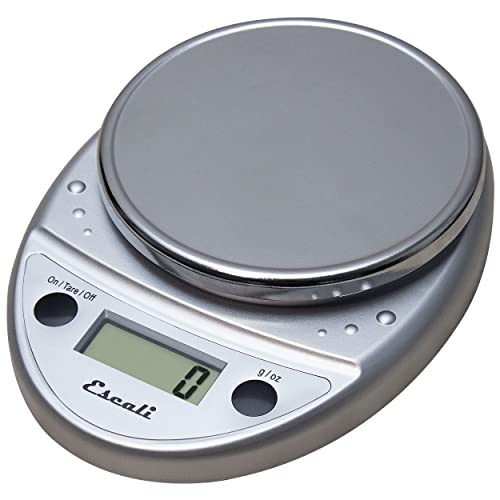
Escali Primo Digital Kitchen Scale
The default cheap kitchen scale. One gram resolution is fine for brines and useless for espresso.

Etekcity 0.1 Gram Food Scale with Bowl
Tenth gram resolution matters the moment you weigh salt as a percentage: 2 percent of 800 grams is 16 grams, and 1 gram resolution is an 6 percent error.

BOMATA Large Kitchen Scale, 0.1 Gram
Tenth gram resolution across a full 11 pound range, which most precision scales give up.
Prices when last checked. They change often.
Why does a tenth of a gram actually matter?
Salt percentage is arithmetic against weight, and weight is only as good as the scale reading it. A typical ferment or brine runs 2 to 5 percent salt by the combined weight of the vegetable or protein and any added water. Take an 800 gram batch at 2 percent: that is 16 grams of salt. A scale that only reads whole grams rounds that reading up or down by as much as a gram, which is roughly 6 percent error on the salt itself, and salt percentage is the one variable that decides whether a ferment tastes right or turns to mush. A 0.1 gram scale cuts that error down to a rounding error nobody would notice.
- Brines and ferments: see the fermentation salt percentage calculator and the brine calculator for the ratios themselves.
- Espresso: brew ratio is also a weight ratio, worked out on the espresso brew ratio calculator.
Which scale should you actually buy?
Of the four scales worth considering here, two read in whole grams and two read to a tenth of a gram. If you only ever bake and portion food, whole-gram resolution on Escali Primo or OXO 11 lb scale is fine. The moment a recipe gives you a percentage rather than a fixed weight, a tenth-gram scale stops being a luxury.
| Model | Resolution | Capacity | Price |
|---|---|---|---|
| Escali Primo | 1 g | 11 lb | $25.00 |
| OXO 11 lb scale | Whole units, pull-out display | 11 lb | $60.81 |
| Etekcity 0.1 g scale | 0.1 g | With bowl | $18.99 |
| BOMATA 0.1 g scale | 0.1 g | 11 lb, large platform | $33.88 |
Do you need a bowl, or a flat platform?
Etekcity 0.1 g scale comes with a bowl built for the tare-and-weigh routine a small brine or ferment batch actually uses: tare the empty bowl, add the vegetable, tare again, add the water, then add salt to the target percentage. OXO 11 lb scale takes the opposite approach: a flat platform with a pull-out display so you can see the number under a wide mixing bowl that would otherwise block a normal scale's screen. BOMATA 0.1 g scale splits the difference with a large flat platform and full tenth-gram resolution, which is the one to reach for once a batch outgrows a standard bowl.
What else is a precision scale good for beyond salt percentage?
Once a tenth-gram scale is on the counter, it earns its keep well past fermentation. Espresso brew ratio is dose weight against yield weight, not a volume measurement at all, which is why the espresso ratio calculator assumes a scale under the portafilter. Ice cream bases are also ratio-driven: total solids from fat and sugar decide texture, covered on the ice cream base ratio calculator. And a cost-per-serving comparison across a batch recipe, worked out on the batch cost per serving calculator, only means something if the batch weight it is based on is accurate.
What actually makes a cheap scale inaccurate?
Most scale complaints in owner reviews trace back to one of three causes rather than a genuinely faulty unit. Off-center loading is the biggest one: setting a tall, narrow container near one edge of the platform rather than centered on it can throw a reading off by a gram or more on a cheap load cell. Skipping the tare step between ingredients is the second, since forgetting to zero the display after adding the bowl carries that bowl weight straight into your salt calculation. The third is temperature: moving a scale from a cold pantry straight onto a warm counter and weighing immediately can produce a drifting reading for the first minute or two before the electronics settle. None of these are reasons to avoid a cheap scale, they are reasons to center the load, tare between steps, and let the scale sit for a moment before trusting the first number.
How we chose
These picks come from published resolution, capacity and included accessories, cross-checked against recurring themes in verified owner reviews about drift and accuracy at low weights, which is where a cheap scale most often fails. We have not weighed a batch on each of these scales ourselves, so verify any single reading against a known calibration weight if a recipe genuinely depends on it.
Gear that fits these numbers
Everything mentioned on this page
Escali Primo Digital Kitchen Scale
The default cheap kitchen scale. One gram resolution is fine for brines and useless for espresso.
BOMATA Large Kitchen Scale, 0.1 Gram
Tenth gram resolution across a full 11 pound range, which most precision scales give up.

OXO Good Grips 11 Pound Stainless Food Scale
The pull out display is the feature: a wide bowl stops hiding the number you are trying to read.
Prices when last checked. They change often.
Frequently asked questions
Is a 0.1 gram scale worth it for everyday cooking?
For most everyday cooking, no: baking a cake or portioning dinner does not need tenth-gram precision, and a 1 gram scale is fine. It becomes worth it the moment a recipe is written as a percentage rather than a fixed amount, which is how brines, ferments and espresso ratios are usually given, since a rounding error on a small percentage becomes a real error in the finished result.
How much salt should go into a brine or ferment by weight?
Most brines run around 5 percent salt by weight of the water, while most vegetable ferments run 2 to 3.5 percent salt by the combined weight of the vegetable and any added water. The exact figure depends on the specific food: firmer vegetables and longer ferments generally want more salt than delicate ones fermented briefly. See the brine and fermentation salt calculators for the specific bands.
Do kitchen scales need to be calibrated?
Most home digital scales use a strain gauge that can drift slightly over time or after being dropped, so an occasional check against a known weight, such as a set of calibration weights or a sealed product with a printed weight on the label, is worth doing if a scale starts giving readings that seem off. Day to day use rarely requires recalibration on a scale that has not been mishandled.
Can you use a food scale for espresso?
Yes, and a scale is the standard tool for dialing in espresso: dose weight going into the portafilter and yield weight coming out of the cup define the brew ratio, which matters more to the final result than time alone. A tenth-gram scale with a built-in timer, rather than a general kitchen scale, is the more common choice for this specifically because espresso doses are small.
What is the difference between a 1 gram and a 0.1 gram kitchen scale?
A 1 gram scale rounds every reading to the nearest whole gram, while a 0.1 gram scale reads to a tenth of that. On a large weight the difference barely matters, but on a small weight, such as 16 grams of salt for a brine, a whole-gram rounding error is a meaningfully larger percentage of the total than the same rounding error on a 0.1 gram scale.
Should you weigh salt by volume instead if you do not own a precise scale?
Volume measurements for salt are unreliable because density varies significantly between types: a tablespoon of fine table salt weighs noticeably more than a tablespoon of flaky kosher salt, so a recipe written by volume can be off by a wide margin depending on which salt is in the container. Weighing salt on any digital scale, even a whole-gram one, is more consistent than measuring it by the spoonful.
Sources
Published figures, quoted as published. We do not generate our own time and temperature data.
How we research: we compare manufacturer specifications, owner manuals, published USDA and FSIS figures and recurring themes in verified owner reviews. We do not cook test batches or run instruments, and nothing here is professional food safety advice. When a figure is not published by a source we trust, we say so rather than estimate one.