Cosori food dehydrator review: a rear fan and 6.5 square feet of stainless trays
The Cosori Food Dehydrator with 6 stainless steel trays costs $143.97, offers 6.5 square feet of drying space, and uses a rear mounted fan that dries every tray at the same rate, which is why it does not require rotating trays partway through a cycle.
The Cosori 6 tray dehydrator costs $143.97 and its most practical feature is the fan placement: a rear mounted, horizontal fan that pushes air evenly across every tray at once, rather than a fan mounted at the top or bottom that dries the nearest tray faster than the farthest one. Stainless trays rather than plastic matter specifically at the temperatures jerky requires, where some plastics are not rated to hold up over long, hot cycles. It is a mid sized machine, not the largest or smallest in the Cosori line, and that middle size is the right fit for most households making jerky or fruit leather regularly without processing a full garden harvest at once.
Why does a rear fan mean you never have to rotate trays?
A rear or horizontal fan pushes air across the full depth of the cabinet at once, so every tray sits in the same airflow path and dries at roughly the same rate. Older and cheaper stacked round dehydrators mount the fan at the base, which means air has to pass through the bottom tray before it reaches the top one, picking up moisture along the way and arriving at the top tray warmer and wetter than it left the fan. That design forces you to physically rotate trays partway through a cycle to even out the drying. The Cosori's rear fan design is the reason its manual does not include a rotation step, and it is the single biggest practical difference between a horizontal flow dehydrator and a stacked one.
| Specification | Value |
|---|---|
| Trays | 6 stainless steel |
| Drying area | 6.5 sq ft |
| Airflow | Rear fan, horizontal |
| Price | $143.97 |
How much does slice thickness and kitchen humidity actually change drying time?
Dehydrator time scales roughly with slice thickness: a slice cut twice as thick takes roughly twice as long to dry, since moisture has to migrate the same relative distance to the surface regardless of the food. A humid kitchen adds time on top of that, typically around 25 percent longer than the same recipe run in a dry kitchen, because the dehydrator is working against a smaller difference between the air inside the cabinet and the air it is drawing in from the room. The dehydrator time calculator accounts for both variables rather than giving one fixed number for a food regardless of how it was cut or where it is being dried. Manufacturer manual ranges, like Cosori's own published times, are starting points to check against the food's actual texture, not a guarantee that a slice cut thicker than the reference will finish in the same window.
Does drying jerky in this machine make it safe to eat?
No, and this is worth stating plainly: drying alone does not make jerky safe. The published USDA guidance is to bring meat to its safe minimum internal temperature either before or after the drying step, not to rely on the dehydrator's temperature setting alone to eliminate pathogens over the course of drying. For ground meat that safe minimum is 160 F, and for whole muscle cuts it is 145 F with a 3 minute rest, figures that come from the USDA FSIS Appendix A lethality tables, which we do not reproduce here. The jerky safety and temperature guide covers how to combine a dehydrator cycle with a heating step correctly. A stainless tray dehydrator like the Cosori running at the temperature its jerky preset specifies is a drying tool, and the temperature verification step still needs a separate check with an accurate thermometer such as the Thermapen ONE.
Is the 6 tray size the right one, or should you buy larger or smaller?
the Cosori 5 tray at $119.99 offers 3.1 square feet, roughly half the drying space of the 6 tray unit, and is the right size for someone drying small batches of fruit or the occasional pound of jerky rather than processing in volume. the Cosori 10 tray at $299.99 more than doubles the drying area to 16.2 square feet, which is a harvest sized machine built for someone preserving a garden's worth of produce in a single session rather than a weeknight batch of jerky. The 6 tray sits in the middle deliberately: enough space for a full pound or two of jerky or several trays of fruit leather at once, without the counter footprint of the largest model.
| 5 tray | 6 tray | 10 tray | |
|---|---|---|---|
| Drying area | 3.1 sq ft | 6.5 sq ft | 16.2 sq ft |
| Price | $119.99 | $143.97 | $299.99 |
| Best for | Occasional small batches | Regular household batches | Harvest sized volume |
Who should buy the alternatives instead?
If square footprint on the counter matters more than capacity, buy the Cosori 5 tray instead and accept a smaller batch per cycle. If you want a square box with true horizontal airflow across a wider temperature range and are prepared to pay for it, the Excalibur Performance Series 10 tray at $379.99 is the machine most long form drying guides are written around, though it costs well over double the Cosori 6 tray. the Excalibur Select Series at $179.99 is the cheaper way into that same horizontal airflow design without the full Performance Series price. The Cosori 6 tray is the practical middle: stainless trays, even drying with no rotation, and a price that does not require buying into the Excalibur brand's premium to get most of the same result.
Gear that fits these numbers
Everything mentioned on this page
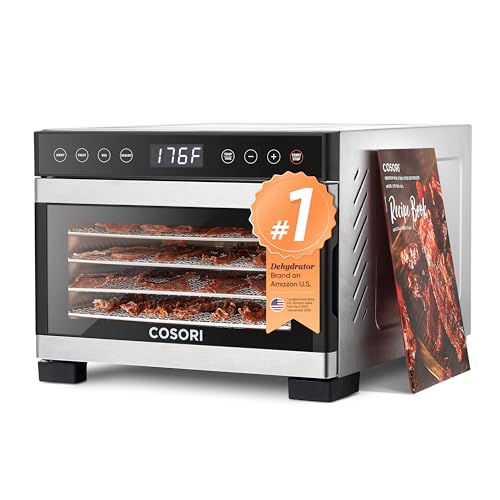
Cosori Food Dehydrator, 5 Stainless Trays
The small one, and still stainless trays rather than plastic, which matters at the 160 F jerky temperature.
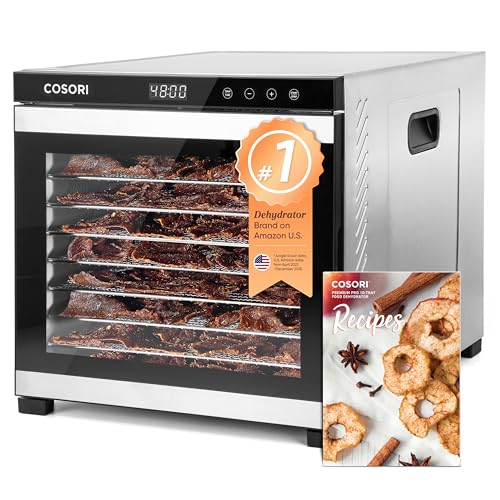
Cosori Food Dehydrator, 10 Stainless Trays
Sixteen square feet of tray, which is a harvest sized machine rather than a jerky sized one.

Excalibur Performance Series Food Dehydrator, 10 Tray
The square box with horizontal airflow that every long form drying guide is written around.

Excalibur Select Series Food Dehydrator
The cheaper Excalibur, with the same horizontal airflow that makes the brand worth the premium in the first place.

ThermoWorks Thermapen ONE
One second and half a degree. On a page about pasteurization that accuracy is not a luxury, it is the difference between a figure meaning something and not.
Prices when last checked. They change often.
Frequently asked questions
Does the Cosori dehydrator need trays rotated partway through a cycle?
No, its rear mounted horizontal fan pushes air evenly across every tray at once, unlike a base mounted or top mounted fan design where air passes through some trays before others and picks up moisture along the way. That even airflow is the entire reason the manual does not include a rotation step, which most stacked round dehydrators require to dry evenly.
Is drying jerky in the Cosori enough to make it safe on its own?
No, drying alone does not make jerky safe. Published USDA guidance calls for bringing meat to its safe minimum internal temperature, either before or after the drying step, in addition to the drying itself. Those temperature figures come from the USDA FSIS Appendix A lethality tables, and a dehydrator's drying cycle is not a substitute for that separate heating step.
How much longer does a humid kitchen make a dehydrator cycle take?
Roughly 25 percent longer than the same food dried in a dry kitchen, because the dehydrator's ability to pull moisture out of food depends on the difference between the humidity inside its cabinet and the air it draws in from the room. On a very humid day, checking food a bit earlier and continuing if it has not reached the target texture is more reliable than trusting the clock alone.
What is the difference between the Cosori 6 tray and 10 tray models besides tray count?
The main difference is total drying area, 6.5 square feet against 16.2 square feet, and the 10 tray's larger cabinet takes up meaningfully more counter or storage space. Both use the same rear fan airflow design and stainless steel trays, so the choice mostly comes down to how much food you process in a typical batch rather than a difference in drying technology.
Can the Cosori dehydrator make fruit leather without special accessories?
It can with an added silicone sheet, since fruit puree would otherwise run through the mesh or perforated tray surface. Silicone dehydrator sheets with raised edges are inexpensive and widely sold separately, and without one, pureed fruit spreads and drips through the trays instead of forming a solid sheet.
Does slice thickness matter as much as the dehydrator's temperature setting?
Yes, arguably more for total time. Dehydrator time scales roughly with thickness, so a slice cut twice as thick takes roughly twice as long regardless of temperature, while the temperature setting mostly affects whether the food dries evenly without cooking the surface before the inside finishes. Cutting food to a consistent thickness across a batch is what keeps pieces finishing at the same time.
Sources
Published figures, quoted as published. We do not generate our own time and temperature data.
How we research: we compare manufacturer specifications, owner manuals, published USDA and FSIS figures and recurring themes in verified owner reviews. We do not cook test batches or run instruments, and nothing here is professional food safety advice. When a figure is not published by a source we trust, we say so rather than estimate one.